Best Overdrive Pedal for Blues: 7 Pedals That Nail the Tone
From transparent boosts to thick saturation, these 7 overdrive pedals deliver authentic blues tone for Strat and Les Paul players alike.
Music Gear Specialist Review Desk
Gear Research & Analysis
ℹ️ Affiliate Disclosure: Music Gear Specialist earns from qualifying purchases through Amazon and other partner links. This doesn't affect our recommendations—we only suggest gear we'd use ourselves.
Blues tone lives and dies on the overdrive pedal. Get it right and every note sings with warmth, sustain, and that vocal quality that makes the guitar weep. Get it wrong and you sound like you are playing through a broken speaker in a fast food drive-through.
The perfect blues overdrive responds to your fingers. Pick softly and it stays clean. Dig in and it growls. Roll back the guitar volume knob and it cleans up without losing clarity or getting muddy. That dynamic interaction between player, guitar, and pedal is what separates great blues tone from generic distortion.
This is a research-desk shortlist, not a scored bench of a house fleet. The circuits below are the ones blues listings, manufacturer pages, and player reports keep returning to — Tube Screamer mid-hump, Klon-style transparent boost, Blues Driver asymmetric clip — on both single-coil and humbucker guitars. Music Gear Specialist Review Desk did not run a 20-pedal A/B to rank them.
What Makes a Great Blues Overdrive
Touch sensitivity is the single most important characteristic. You need to hear and feel the difference between a light pick stroke and an aggressive attack. Pedals that compress everything to the same volume level kill the expressive dynamics that define blues playing.
The mid-range character shapes everything. Blues overdrive typically has a slight mid-range boost that helps the guitar cut through a band mix and gives notes a vocal, singing quality. Scooped mids sound great alone but disappear on stage.
Volume knob cleanup is essential. The greatest blues players use their guitar’s volume knob as an active control, rolling it back between verses for clean passages and cranking it for solos. A good overdrive should transition smoothly from clean to dirty as you adjust the volume, not switch abruptly between two disconnected sounds.
The 7 Best Blues Overdrive Pedals in 2026
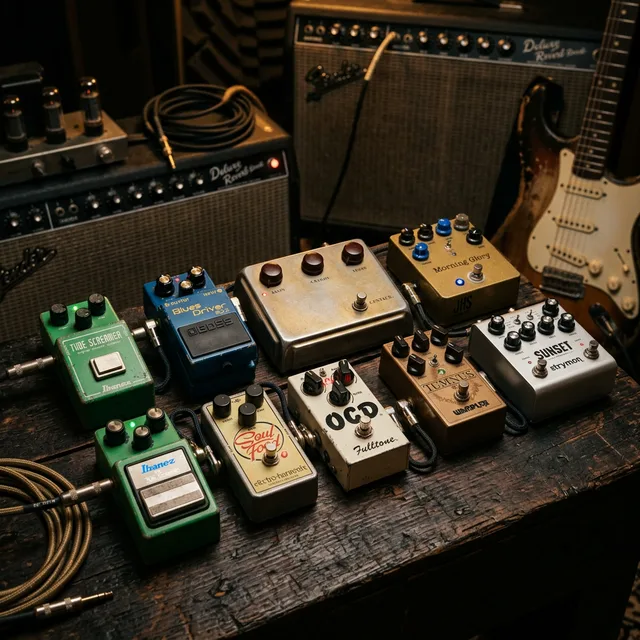
1. Ibanez Tube Screamer TS9 — The Blueprint
Every blues overdrive conversation starts here. The TS9 has defined the sound of blues guitar since Stevie Ray Vaughan plugged one into a cranked Fender Vibroverb in the early 1980s. The signature mid-hump circuit boosts frequencies around 700Hz-1kHz, giving your guitar a thick, present voice that sits perfectly in a band context.
The TS9 excels as both a standalone overdrive at moderate gain settings and as a clean boost to push a tube amp into natural breakup. With the drive knob at 9 o’clock and the level cranked, it becomes a transparent boost that preserves your guitar’s character while adding just a touch of warmth.
Price: ~$100 | Best for: Classic blues, SRV-style Texas blues, blues-rock
2. EHX Soul Food — Best Budget Option
The Soul Food is Electro-Harmonix’s take on the legendary Klon Centaur, a pedal that sells for $2,000+ on the used market. For $70, you get remarkably close to that transparent, sparkly overdrive character that boosts your amp without coloring your tone drastically.
Where the Tube Screamer pushes mids, the Soul Food is flatter across the frequency spectrum, letting your guitar and amp combination shine through with added grit. It is the better choice for players who want to preserve their core tone rather than reshape it.
Price: ~$70 | Best for: Transparent boost, modern blues, players who want to hear their guitar and amp uncolored
3. Boss Blues Driver BD-2 — Best for Strat Players
The BD-2 was literally designed for blues, and it earns the name. The clipping character is asymmetric, producing a blend of even and odd harmonics that sounds like a small tube amp breaking up naturally. Through a clean Fender amp with a Stratocaster, the BD-2 absolutely nails the John Mayer Continuum era tone.
The gain range is wider than the Tube Screamer, going from barely-there grit to aggressive crunch that approaches distortion territory. This makes it versatile enough to cover everything from jazzy clean boost to hard-driving Chicago blues.
Price: ~$100 | Best for: Strat-into-Fender players, Mayer-style blues, wide gain range needs
4. Fulltone OCD V2 — Best for Les Paul Players
The OCD is a different beast from the Tube Screamer and its clones. Where the TS9 is smooth and compressed, the OCD is raw and open. It reacts to your picking dynamics with an almost aggressive sensitivity — whisper on the strings and it purrs, attack hard and it bites back with authority.
The HP/LP switch toggles between high-peak and low-peak clipping modes. HP mode tightens the low end and adds aggression, working brilliantly with humbuckers. LP mode keeps the bass response fuller and sounds more traditional with single coils. This switchability makes the OCD one of the most versatile overdrive pedals on the market.
Price: ~$140 | Best for: Les Paul players, dynamic blues-rock, players who want aggressive edge
5. JHS Morning Glory V4 — Best Transparent Overdrive
The Morning Glory is designed to sound like a cranked Marshall Bluesbreaker, and it delivers. This pedal is all about adding grit and sustain while preserving the fundamental character of your guitar and amp. If you spent $2,000 on your dream rig and you do not want a pedal to reshape that tone, the Morning Glory respects your investment.
The bright cut switch tames high-frequency harshness on brighter guitars, and the gain range goes from barely audible warmth to medium crunch. It stacks beautifully with other pedals — run a Tube Screamer into a Morning Glory for a two-stage blues overdrive that covers everything from whisper-clean to screaming lead tones.
Price: ~$220 | Best for: Transparent tone preservation, stacking with other pedals, boutique quality
6. Boss SD-1 Super Overdrive — Best Under $60
The SD-1 is often overlooked because it costs less than dinner for two, but it shares the same asymmetric clipping topology as the Tube Screamer with a brighter, more open top end. Blues guitarist Buddy Guy used an SD-1 for years, and his tone was never anything less than devastating.
The SD-1 has slightly less mid-range push than the TS9, which can actually be an advantage for humbucker players who already have plenty of midrange from their pickups. It is also a fantastic “always-on” pedal that just adds a subtle warmth and push to your clean tone.
Price: ~$60 | Best for: Budget-conscious players, humbucker guitars, always-on subtle warmth
7. Wampler Tumnus Deluxe — Best Premium Option
The Tumnus Deluxe is another Klon-inspired circuit, but Wampler added a three-band EQ that gives you far more tone-shaping control than the original ever offered. The base circuit delivers that transparent, touch-sensitive overdrive that made the Klon famous, while the EQ lets you tailor it precisely to your rig.
The buffered bypass with trails maintains your signal integrity even when the pedal is off, which matters if you run a large pedalboard. The build quality is impeccable, with a rugged aluminum enclosure, smooth pots, and a soft-click footswitch that will survive decades of stomping.
Price: ~$200 | Best for: Players who want premium build quality and tone-shaping flexibility
How to Set Your Blues Overdrive
Start with everything at noon, then adjust from there. But here is a more targeted approach:
For rhythm blues: Drive at 9-10 o’clock, tone at noon, level slightly above unity (matching your clean volume). This gives you a warm, lightly broken-up tone that cleans up when you pick softly.
For lead blues: Drive at 1-2 o’clock, tone slightly above noon, level boosted above unity to push the amp harder. The extra gain provides sustain for bends and vibrato, and the volume boost helps solos cut through the band.
For the “always-on” approach: Drive at 7-8 o’clock (minimum), level at 2 o’clock. This uses the overdrive as a clean boost, adding warmth and fullness without audible distortion. Many professional blues players leave a Tube Screamer or Klon on for the entire set using this setting.
Stacking Overdrives for Maximum Blues Tone
Many blues players use two overdrive pedals together. The first pedal (usually a transparent boost like a Klon clone) stays on to add warmth and body. The second pedal (usually a Tube Screamer type) kicks in for solos to add gain and mid-range push on top of the base tone.
Order matters. Place your lower-gain pedal first in the signal chain and your higher-gain pedal second. This way the second pedal amplifies and saturates the slightly dirty signal from the first, creating a thick, harmonically rich lead tone that cleans up beautifully when you disengage the second pedal.
Two pedals is the useful stack. A third overdrive before you have set amp EQ is just another mid-hump on top of the first two.
Buying notes (what to check before you click)
Listing checks Amazon copy skips. Tube Screamer / Soul Food / Blues Driver street prices on this page are a research snapshot, not a live offer.
Use-case fit
- Mid-hump into a clean or edge-of-breakup amp: Ibanez Tube Screamer TS9. Confirm TS9 vs TS808 vs a Keeley-modded TS in the title, not a generic “screamer” graphic.
- Transparent boost that does not restack mids: EHX Soul Food or Wampler Tumnus. Those are Klon-style listings, not a $2,000 Centaur.
- Strat vs Les Paul as the guitar: Fender vs Gibson. Stage volume after the pedal is wireless in-ear monitors, not a third overdrive.
When to skip / when to buy
- Skip stacking three OD pedals before a good amp EQ. Bass / mids / treble on the amp is cheaper than a third box that restacks 700 Hz.
- Skip a “Klon Centaur” used listing that is a graphic, not a serial. Buy Soul Food or Tumnus if you want that circuit family.
- Skip a TS808 because a forum said it is “smoother” if the listing is a reissue sitting next to a TS9. Taste, not a different physics.
- Buy one mid-hump or one transparent boost first. Add the second only after the amp EQ is set.
Listing checks the product title usually omits
- TS9 vs TS808 vs Keeley. Same Tube Screamer mid-hump family; Keeley Super Phat Mod and kept-TS mods are not a third topology.
- Klon-style vs actual Klon. Soul Food, Tumnus, and “Centaur” clones share a listing photo language Amazon will not disambiguate.
- Buffered vs true bypass. A large board cares; a one-pedal carpet does not.
- 9V only vs 18V OCD-class. Voltage in the bullets is not optional.
- Mini enclosure vs standard. Mini TS clones often skip the same EQ range.
Next reads: pedals hub · best music gear roundups.
FAQ
What overdrive pedal is best for blues?
The Ibanez Tube Screamer TS9 remains the gold standard. Its mid-hump circuit produces smooth, singing breakup that cleans up beautifully with guitar volume adjustments. Nearly every iconic blues guitarist has used one at some point.
What is the difference between overdrive and distortion for blues?
Overdrive simulates a tube amp being pushed past its clean threshold with warm, dynamic breakup. Distortion provides harder, more compressed clipping with less dynamic range. Blues players prefer overdrive because it preserves touch sensitivity.
Should I buy a Tube Screamer or a Klon clone for blues?
A Tube Screamer adds a mid-range hump that thickens your tone and helps it cut through a mix. A Klon clone is more transparent, boosting your signal without reshaping the frequency response. If you want to change your tone, go Tube Screamer. If you want to enhance it, go Klon clone.
Can I use an overdrive pedal with a solid state amp for blues?
Yes, but the interaction is different. Overdrive pedals into solid state amps produce their tone entirely from the pedal’s clipping circuit, rather than pushing amp tubes into breakup. The Boss BD-2 and EHX Soul Food sound particularly good into solid state amps because they have their own rich harmonic character independent of the amp.

Music Gear Specialist Review Desk
Research-based reviewsResearch-based reviews · Manufacturer specs · Verified owner feedback
We review guitars, amps, pedals, and recording gear the honest way: spec sheets, published measurements, and the collected experience of working musicians and verified owners.