How to Learn Guitar at Home Without a Teacher: A Realistic Roadmap
You do not need a $60/hour instructor to learn guitar. Here is a 12-month plan using free resources that works for self-taught players.
Music Gear Specialist Review Desk
Gear Research & Analysis
ℹ️ Affiliate Disclosure: Music Gear Specialist earns from qualifying purchases through Amazon and other partner links. This doesn't affect our recommendations—we only suggest gear we'd use ourselves.
Private guitar lessons cost $40-$80 per hour in most cities. At one lesson per week, that is $2,000-$4,000 per year. For many aspiring guitarists, that number kills the dream before it starts. But here is the truth that guitar teachers do not advertise: you do not need one to learn guitar. You need a structured approach, consistent practice, and the discipline to work through frustrating plateaus without someone standing over your shoulder.
The internet has democratized music education in ways that would have been unthinkable 20 years ago. Free video lessons, interactive apps, community forums, and backing tracks give self-taught players access to teaching quality that rivals — and sometimes exceeds — what local instructors provide.
This is not motivational fluff. This is a concrete, month-by-month roadmap for learning guitar at home.
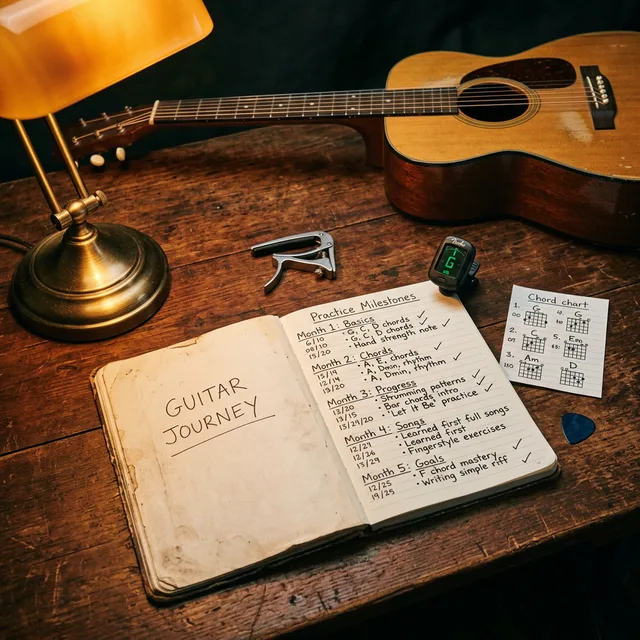
Month 1-2: Building the Foundation
Your only goals for the first two months are developing calluses, learning basic open chords, and establishing a daily practice habit. Everything else is noise. If you have not bought an instrument yet, start with our best advice for beginner acoustic guitar players in 2026 so your first guitar does not make the first month harder than it needs to be.
The Essential First Chords
Learn these eight open chords in this order: Em, Am, E, A, D, G, C, F. This sequence is deliberate. Em and Am require only two fingers and build immediate confidence. E and A add a third finger. D introduces a new hand shape. G stretches your fingers across more frets. C requires precise finger placement. F introduces the dreaded barre technique at its simplest form.
Practice transitioning between chords more than you practice holding them. The ability to switch from G to C to D smoothly is what makes songs sound like songs. Spend 10 minutes per practice session on chord transitions using a metronome set at a painfully slow tempo — 40-50 BPM. Speed comes from accuracy, not from rushing.
The 30-Minute Practice Routine
Split every practice session into three blocks:
- 10 minutes: Warm-up and chord transitions with a metronome
- 10 minutes: Learning a new chord or technique from your lesson plan
- 10 minutes: Playing a song you enjoy, even if imperfectly
That last block is crucial. If every practice session is pure exercise with no music, you will burn out within a month. Playing actual songs, even badly, reminds your brain why you picked up the guitar in the first place.
Free Resources That Work
JustinGuitar.com is the gold standard for free guitar education. Justin Sandercoe’s beginner course is structured, progressive, and has taught millions of players worldwide. Start at Module 1 and follow the sequence exactly. Do not skip ahead because a lesson feels “too easy.”
Fender Play offers a free 14-day trial and costs $10/month afterward. The interface is polished and the song-based approach keeps beginners engaged. It is worth trying to see if the format clicks with your learning style.
Ultimate Guitar (tabs and chords) will be your song library. The free version has everything you need. Search for songs labeled “beginner” and look for those that use only the chords you already know.
Month 3-4: Expanding Your Vocabulary
By month three, your fingertips should have calluses, chord transitions should feel less like solving a puzzle, and you should be able to play at least 3-5 simple songs from memory.
Introduce Barre Chords
Barre chords are the wall where most self-taught guitarists quit. Your index finger must press all six strings simultaneously while your other fingers form chord shapes. It hurts, it sounds terrible at first, and it takes weeks of daily practice before the notes ring clean.
Start with the F major barre chord at the first fret. Practice it for five minutes per day — no more. Excessive barre chord practice strains the hand and causes injury. When F major rings clean 8 out of 10 times, move the same shape up to the third fret (G major) and fifth fret (A major). Congratulations, you now know every major chord.
Start Learning Strumming Patterns
Most beginners strum in a monotonous down-down-down-down pattern. Real songs use combinations of downstrokes and upstrokes with specific rhythmic emphasis. Learn these three patterns and you can play 80% of popular music:
- D-DU-UDU (the universal folk/pop pattern)
- D-D-DU-D-D-DU (country and acoustic rock)
- D-U-D-U with muted strums on beats 2 and 4 (funk and R&B)
Practice each pattern with a metronome until it becomes automatic. You should be able to strum the pattern while having a conversation — that is when you know it is internalized.
Month 5-8: Developing Real Skills
This is where self-taught players often stall because there is no teacher to push them past comfort zones. You must become your own coach.
Learn the Pentatonic Scale
The minor pentatonic scale is the foundation of rock, blues, and pop guitar soloing. Learn it in the key of A minor (fifth fret) first. Practice it ascending and descending until your fingers find the notes automatically. If your goal is to learn guitar in 3 months, start by playing the scale over a backing track slowly; this is where scale practice transforms from boring exercise to actual music making.
Start Fingerpicking
Fingerpicking opens up an entirely different world of guitar music. Start with a simple Travis picking pattern: your thumb alternates between the bass strings (6, 5, 4) while your index, middle, and ring fingers pluck the treble strings (3, 2, 1) in a repeating pattern.
Learn “Dust in the Wind” by Kansas or “Blackbird” by The Beatles. Both songs use fundamental fingerpicking patterns that transfer to dozens of other songs.
Record Yourself
This is the most important self-teaching tool that most beginners ignore. Record yourself playing once a week using your phone. Do not share it. Just listen back. You will hear timing issues, missed notes, and inconsistencies that you cannot detect while playing. This objective feedback replaces what a teacher’s ear would catch in a lesson.
Month 9-12: Becoming a Real Player
Learn Complete Songs
Stop learning only the verse or only the chorus. Commit to learning entire songs from intro to outro, including any instrumental sections. Playing a complete song from memory builds the stamina, focus, and confidence that define a real guitarist versus someone who “knows a few chords.”
Aim to have a repertoire of 10-15 complete songs by month 12. Include a mix of easy songs you can play flawlessly and challenging songs that stretch your abilities.
Understand Basic Music Theory
You do not need a music degree, but understanding why chords work together will accelerate your growth exponentially. Learn the Nashville Number System, which assigns numbers to chords based on their position in a key. Once you understand that most pop songs use the 1-5-6-4 progression, you can figure out hundreds of songs by ear without looking up tabs.
Learn the notes on the low E and A strings. Combined with your barre chord shapes, this knowledge lets you play any chord anywhere on the neck instantly.
Play With Other People
Find a friend who plays, attend a local jam night, or join an online community where people share recordings. Playing with others exposes weaknesses you did not know you had — timing issues, inability to follow chord changes at tempo, and volume control. It is terrifying and it is the single fastest way to improve.
Common Mistakes Self-Taught Guitarists Make
Practicing only what you are good at. It feels great to play songs you already know, but growth happens at the edge of your ability. Spend at least 30% of practice time on things that are difficult.
Ignoring timing. Playing the right notes at the wrong time sounds worse than playing wrong notes at the right time. Use a metronome for everything. The free Soundbrenner app works perfectly.
Never slowing down. If you cannot play a passage cleanly at 60 BPM, you cannot play it at 120 BPM. Slow down until every note rings perfectly, then increase tempo by 5 BPM increments.
Excessive gear shopping. Buying a new guitar or pedal feels like progress but it is not. The time you spend researching the best beginner guitar would be better spent practicing on the one you already own.
FAQ
Can I really learn guitar without a teacher?
Yes. Many professional guitarists are entirely self-taught. The key is following a structured curriculum like JustinGuitar rather than randomly watching YouTube videos. Consistency beats instruction quality every time.
How long does it take to learn guitar by yourself?
With 30 minutes of daily practice, expect to play simple songs within 1-2 months, handle barre chords by month 4-6, and have a solid repertoire of 10-15 songs by month 12. Daily consistency matters far more than session length.
What if I get stuck and cannot figure something out?
Online guitar communities like r/guitar on Reddit, the JustinGuitar forum, and various Discord servers are full of experienced players who answer questions for free. Post a video of what you are struggling with and you will get specific, actionable advice within hours.
Do I need to read sheet music?
No. The vast majority of guitar players use tablature (tabs), which shows you exactly which frets to press without requiring any music reading knowledge. Learning standard notation is valuable but completely optional for most styles.
Is 30 minutes a day really enough?
Yes, if it is focused practice with specific goals. Thirty minutes of deliberate practice with a metronome and a clear objective accomplishes more than two hours of unfocused noodling. Quality always beats quantity.

Music Gear Specialist Review Desk
Research-based reviewsResearch-based reviews · Manufacturer specs · Verified owner feedback
We review guitars, amps, pedals, and recording gear the honest way: spec sheets, published measurements, and the collected experience of working musicians and verified owners.