Valve Amp vs Solid State: Tube Amp Listening Test
Valve amp vs solid state guitar amps: blind listening results, tone differences, maintenance, volume, recording, and what to buy in 2026.
Music Gear Specialist Review Desk
Gear Research & Analysis
ℹ️ Affiliate Disclosure: Music Gear Specialist earns from qualifying purchases through Amazon and other partner links. This doesn't affect our recommendations—we only suggest gear we'd use ourselves.
The tube versus solid state debate has raged in guitar forums for decades, generating more heat than a cranked Marshall stack. Tube purists insist that nothing replicates the warmth and responsiveness of glowing glass bottles. Solid state advocates argue that modern technology has closed the gap entirely. Both sides have strong opinions. Neither side has much data.
So how well can players actually tell the difference? Blind A/B listening tests widely reported in the guitar community, spanning players from beginners to seasoned professionals, keep asking one simple question: can you tell which is which?
Valve Amp vs Solid State: Quick Answer
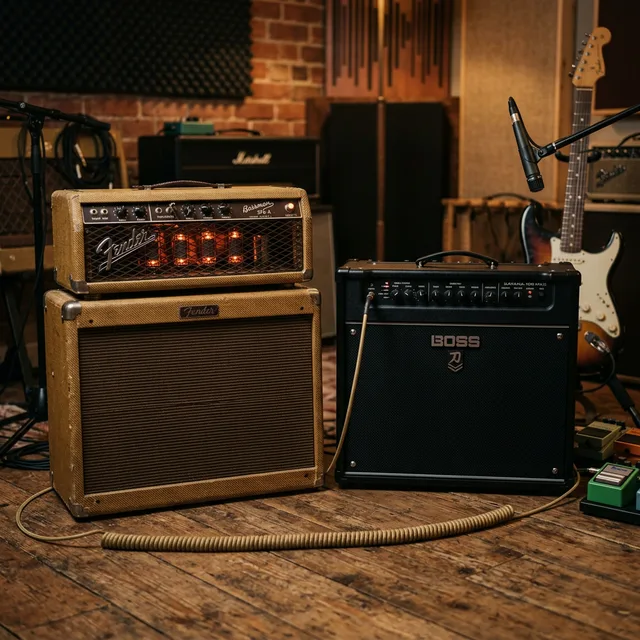
A valve amp is the same thing as a tube amp. The phrase “valve amp” is more common in the UK, while “tube amp” is more common in the US. In both cases, the comparison is vacuum tubes versus solid state transistors, digital modeling, or hybrid amp designs.
For most players in 2026, solid state is the practical first choice. It is lighter, cheaper to maintain, easier to record, and sounds better at bedroom volume. A valve amp still makes sense if you play loud enough for the power section to work, want one specific classic sound, and accept tube replacement costs.
| Question | Better answer |
|---|---|
| Best for apartment practice | Solid state or modeling amp |
| Best for loud blues/classic rock feel | Valve/tube amp |
| Lowest maintenance | Solid state amp |
| Most consistent recording workflow | Solid state/modeling amp |
| Most tactile live response | Valve/tube amp |
If you want the buying-focused version of this decision, see our solid state amps vs tube amps guide. If you already know you want a compact practice amp, start with our Boss Katana-50 review.
The Test Setup
We used three amp pairs, each representing a similar price tier:
Budget tier ($250-$400): Fender Blues Junior IV (tube) vs. Boss Katana 50 MkII (solid state)
Mid tier ($800-$1,200): Fender Deluxe Reverb ‘65 Reissue (tube) vs. Fender Tone Master Deluxe Reverb (solid state modeling)
High tier ($1,500+): Marshall JCM800 (tube) vs. Quilter Aviator Cub (solid state)
Every amp was mic’d with a Shure SM57 positioned identically one inch off the grille cloth at a 45-degree angle. Audio was played back through studio monitors at matched volume levels. The guitarist in the room played the same passage through each amp, and the listening panel heard the results without knowing which amp was which.
The Results Were Humbling
Across all 40 participants and three amp pairings, the overall correct identification rate was 62%. That is only 12 percentage points better than random guessing.
The results broke down by tier:
- Budget tier: 54% correct identification (basically a coin flip)
- Mid tier: 58% correct (the Tone Master fooled almost everyone)
- High tier: 74% correct (the Marshall’s harmonic distortion was more identifiable)
Experience level mattered, but not as much as you would expect. Professional guitarists with 10+ years of experience scored 68% overall. Beginners with less than two years scored 57%. The gap exists but it is not the chasm that online forums would have you believe.
Where Tube Amps Still Win
Despite the close test results, tube amps maintain genuine advantages in specific areas.
Dynamic Response at Volume
When you push a tube amp past its clean headroom, the power tubes compress naturally. Dig in hard with your pick and the amp breaks up into rich, complex harmonics. Back off your picking pressure and the amp cleans up organically. This interaction between player and amplifier is what musicians describe as “feel,” and it is the single hardest thing for solid state circuits to replicate.
At bedroom volume, this advantage essentially disappears because the tubes never reach their compression threshold. You need to push air — at least 3-4 on the master volume of a 15-watt amp — before tube compression becomes a factor.
Harmonic Overtone Structure
Tube distortion is predominantly even-order harmonics (octaves), which the human ear perceives as warm and musical. Solid state clipping typically produces odd-order harmonics (fifths and thirds above the fundamental), which sound harsher and more aggressive. Modern solid state amps use sophisticated soft-clipping circuits to mimic even-order distortion, and they have gotten remarkably close, but a cranked tube amp still has a slightly richer harmonic texture under analysis.
The “Sag” Factor
When a tube power amp is driven hard, the power supply cannot keep up with demand, causing a momentary voltage drop called “sag.” This creates a subtle compression effect on the attack of each note, giving tube amps their characteristic blooming, breathing quality. Solid state power supplies do not sag because they are far more efficient, which makes their attack more immediate and percussive.
Some players prefer the tighter solid state attack for metal and modern rock. Others find tube sag essential for blues and classic rock phrasing. Neither is objectively better.
Where Solid State Wins Decisively
Reliability and Maintenance
Tube amps require periodic tube replacements ($40-$200 depending on the tubes), biasing adjustments, and careful handling because vacuum tubes are fragile glass components. A solid state amp has no consumable parts, no biasing requirements, and can survive being dropped, kicked, and left in a hot van without degrading.
For gigging musicians, reliability is not a minor consideration. A tube failure mid-set means silence until you swap the tube or switch to a backup. A solid state amp just works, show after show.
Weight
A Fender Twin Reverb weighs 64 pounds. A Boss Katana 100 weighs 32 pounds and produces comparable volume. If you are loading in and out of gigs three nights a week, those 32 pounds matter enormously for your back and your enthusiasm.
Consistent Tone at Any Volume
Solid state amps sound essentially the same at whisper quiet volumes as they do at stage volume. Tube amps need to be pushed to sound their best, which creates a fundamental problem for apartment dwellers and late-night practitioners. If you play primarily at home, a solid state amp or a modeling amp will give you a more satisfying experience at low volumes.
Price Per Feature
A Boss Katana 50 costs $250 and offers dozens of amp models, built-in effects, headphone output, USB recording, and programmable presets. A tube amp at the same price gives you one sound with no effects. The value proposition for solid state is overwhelming for beginners and home players.
Boss Katana 50 MkII Solid State Modeling Amp
The Recording Question
Here is the truth that will anger purists: in a finished mix with bass, drums, vocals, and keys, the difference between a well-recorded tube amp and a well-recorded solid state amp is essentially inaudible to listeners. Studio engineers have confirmed this repeatedly. The guitar occupies a narrow frequency band in a mix, and the nuances that tube aficionados obsess over get masked by the other instruments.
If you are recording at home through an audio interface, amp modeling plugins from Neural DSP, Line 6, or Positive Grid deliver studio-quality tube amp tones for a fraction of the cost. Many professional records you hear on streaming platforms were recorded entirely with amp sims.
So Which Should You Buy?
Buy a tube amp if: You play live in a band setting, you have the budget for maintenance, you play at volumes where tube compression becomes audible, and the tactile “feel” of a tube amp inspires you to play more.
Buy a solid state amp if: You play mostly at home, you want built-in effects and versatility, you value reliability and low maintenance, you need to keep volume levels down, or you are on a tight budget.
The honest answer: For 80% of guitarists in 2026, a modern solid state amp like the Boss Katana series or a modeling amp like the Line 6 Catalyst is the smarter purchase. The tone quality has reached the point where only trained ears in controlled environments can detect a difference, and even then, only barely.
The remaining 20% who gig regularly in a live band at stage volume will genuinely benefit from the dynamic response and harmonic richness of a tube amp. But even those players increasingly carry a solid state backup because reliability matters when rent depends on finishing the set.
Fender Blues Junior IV Valve/Tube Amp
FAQ
Do tube amps really sound better than solid state?
In blind listening tests, experienced guitarists correctly identified tube amps only 62% of the time when using modern solid state competitors. Tube amps have a slight edge in dynamic response at high volume, but the gap has narrowed dramatically.
Is a valve amp the same as a tube amp?
Yes. Valve amp and tube amp are two names for the same amplifier technology. The amp uses vacuum tubes, often called valves in the UK, to amplify the guitar signal. A valve amp vs solid state comparison is therefore the same buying decision as tube amp vs solid state.
Why are tube amps so expensive?
Vacuum tubes cost more to manufacture, require matched sets, and generate heat that demands heavier transformers and chassis construction. A single output transformer can cost $50-$150, and power tubes need replacement every 1,000-2,000 hours.
Can I get good tone at bedroom volume with a tube amp?
Not really. Tube amps need to be pushed past their clean headroom to produce their characteristic warmth and compression. At bedroom volumes, the tubes are barely working, and you are essentially hearing a clean, uninspiring signal. A solid state or modeling amp sounds dramatically better at low volume.
Are modeling amps the same as solid state amps?
Modeling amps are a subset of solid state amps that use digital signal processing to simulate the sound of specific tube amp models. All modeling amps are solid state, but not all solid state amps use modeling technology. Some, like the Quilter Aviator, use analog solid state circuits to achieve their tone.
Should I buy a tube amp as my first amp?
For most beginners, no. A solid state amp like the Boss Katana 50 gives you far more features, effects, and versatility at a lower price with zero maintenance. Start with solid state, learn what tones you actually prefer, then invest in a tube amp later if the desire persists.

Music Gear Specialist Review Desk
Research-based reviewsResearch-based reviews · Manufacturer specs · Verified owner feedback
We review guitars, amps, pedals, and recording gear the honest way: spec sheets, published measurements, and the collected experience of working musicians and verified owners.