Focusrite Scarlett 2i2 Review: Still the Best Budget Audio Interface
Focusrite Scarlett 2i2 4th Gen: the world's best-selling audio interface. After 6 months of daily studio use, here's why it still dominates.
Music Gear Specialist Review Desk
Gear Research & Analysis
ℹ️ Affiliate Disclosure: Music Gear Specialist earns from qualifying purchases through Amazon and other partner links. This doesn't affect our recommendations—we only suggest gear we'd use ourselves.
Focusrite Scarlett 2i2 Review: Still the Best Budget Audio Interface (2026)
The Focusrite Scarlett 2i2 is the best-selling audio interface in the world, and it has been for nearly a decade. Every recording studio supply company, every YouTube gear educator, every college audio program recommends it to beginners.
I’ve owned three generations of the 2i2 since 2015. After 6 months of daily use on the 4th Generation model, here’s my verdict.
Rating: 9.3/10, Best-in-class for home recording
Specs (4th Generation)
| Spec | Detail |
|---|---|
| Price | ~$169 |
| Inputs | 2x XLR/TRS combo jacks (INST switch on CH1) |
| Outputs | 2x TRS balanced (monitors), 1x headphone |
| Preamps | Scarlett 3rd-gen preamps (69dB gain) |
| Sample rate | Up to 192kHz / 24-bit |
| Connectivity | USB-C (cable included) |
| Phantom power | 48V (for condenser mics) |
| Special features | Auto-Gain, Clip Safe, Air mode |
What’s Great
1. The Preamps Sound Excellent for the Price
Focusrite redesigned the Scarlett preamps significantly between the 3rd and 4th generation. At 69dB of gain with -129dBu EIN noise floor, the 2i2 competes with interfaces costing $300+. Guitar tracks recorded through the 2i2 with amp sims sound clean and detailed with very little noise floor.
2. Air Mode Is Real
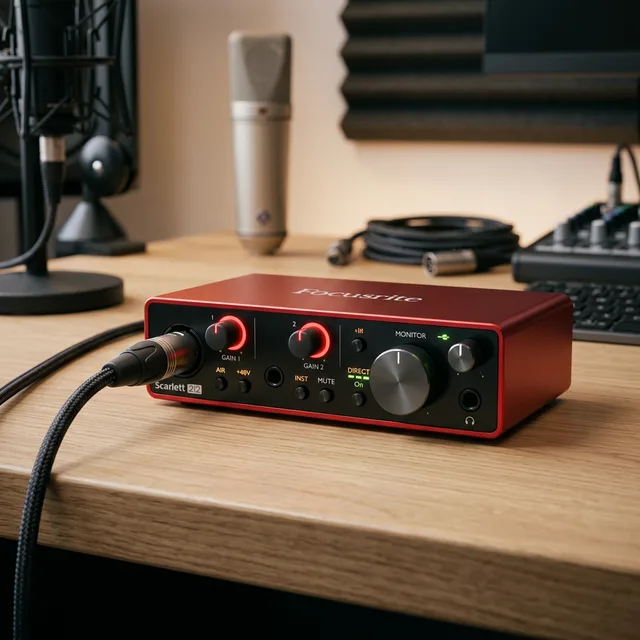
The Air button is named after Focusrite’s high-end ISA transformer preamps. It adds harmonic complexity and high-frequency presence to the preamp circuit, making acoustic guitars and vocals sound noticeably more open and detailed. I use it on every acoustic guitar recording. This alone is worth upgrading from the 3rd Gen.
3. Auto-Gain Is Genuinely Useful for Beginners
Auto-Gain is a new 4th Gen feature: press the button, play normally for 10 seconds, and the 2i2 sets your input gain automatically to an optimal level. For guitarists who’ve struggled with the eternal question of “how hot is too hot?”, this solves it.
4. Zero-Latency Monitoring Hardware Mix
The large center Direct Monitor knob cross-fades between your live input signal (true zero latency, no software involved) and DAW playback. This allows you to monitor yourself in real-time while recording without the ear-fatiguing latency of software monitoring.
5. Plug-and-Play on Every Platform
No drivers needed on Mac (uses Apple Core Audio) or Windows (ASIO4ALL or USB Audio Class 2.0). It also works on iPad with a USB-C cable. Setup time from box to recording: under 5 minutes.
What’s Not Great
1. Only 2 Inputs
If you want to record guitar + vocals simultaneously (common for singer-songwriters), you can, guitar on CH1, mic on CH2. But if you need a drum kit, a piano through multiple mics, or 4+ simultaneous sources, you’ll need the Scarlett 4i4 ($249) or 8i8 ($299).
2. The Headphone Output Is Adequate but Not Hi-Fi
The 2i2’s headphone amp is functional but lacks the volume headroom to drive high-impedance cans (250Ω Beyerdynamic DT 990s, for example) to satisfying levels. For lower-impedance headphones (Audio-Technica ATH-M50x, most earbuds) it’s perfectly fine.
3. No MIDI I/O
If you need to connect a MIDI keyboard without USB, you’ll need a 3rd-party MIDI interface. This is minor for guitar-centric setups.
How It Compares
| Interface | Price | Preamps | Inputs/Outputs | Best For |
|---|---|---|---|---|
| Focusrite Scarlett 2i2 | $169 | Very good | 2 in / 2 out | Most home guitarists |
| PreSonus AudioBox USB 96 | $99 | Good | 2 in / 2 out | Tightest budget |
| Universal Audio Volt 2 | $199 | Very good | 2 in / 2 out | Vintage analog simulation |
| SSL 2+ | $239 | Excellent | 2 in / 2 out | Maximum preamp quality |
| Scarlett 4i4 | $249 | Very good | 4 in / 4 out | More I/O needed |
The Universal Audio Volt 2 ($199) is the closest competitor and matches the 2i2 on preamp quality, its “Vintage” mode analog circuit simulation is excellent. If you’re recording lots of vocals, the Volt 2 is worth the extra $30. For guitar-centric home recording, the 2i2 wins on features (Auto-Gain, Clip Safe, Air).
Setting It Up for Guitar Recording
Signal chain for electric guitar:
- Guitar → 2i2 Channel 1 (press INST button for hi-Z)
- Set gain so green halo ring lights on peaks, never red
- Enable Air mode for more presence
- In your DAW, add amp sim plugin (Amplitube CS free, or BIAS FX 2, or Neural DSP)
Signal chain for acoustic guitar:
- Position microphone (SM57 or AT2020) 12–15” from soundhole at the 12th fret angle
- Connect mic to Channel 1 or 2 (XLR)
- Enable 48V phantom power if using a condenser mic
- Enable Air mode, makes a significant positive difference on acoustic
Final Verdict
The Focusrite Scarlett 2i2 4th Gen earns its position as the world’s best-selling audio interface. The Air mode, Auto-Gain, and Clip Safe features are legitimately useful improvements over the 3rd Gen. The preamps compete with interfaces at twice the price.
Buy it if: You’re starting home recording, need a reliable plug-and-play interface, or are upgrading from the 3rd Gen for Air mode.
Don’t buy it if: You need more than 2 inputs simultaneously.
Score: 9.3/10
Check price on Amazon → | View on Sweetwater →
Related: Best Audio Interfaces for Guitar Recording · How to Record Guitar at Home · Best Microphones for Recording Guitar
We select and review gear independently. To learn more about our testing process, read our Editorial Policy.

Music Gear Specialist Review Desk
Research-based reviewsResearch-based reviews · Manufacturer specs · Verified owner feedback
We review guitars, amps, pedals, and recording gear the honest way: spec sheets, published measurements, and the collected experience of working musicians and verified owners.