Guitar Maintenance: 7 Essential Care Tips (2026)
These 7 guitar maintenance habits, from string cleaning to humidity control, take minutes per week but prevent costly repairs and keep your tone alive.
Mike Reynolds
Professional Guitarist & Audio Engineer · 20+ years
ℹ️ Affiliate Disclosure: Music Gear Specialist earns from qualifying purchases through Amazon and other partner links. This doesn't affect our recommendations—we only suggest gear we'd use ourselves.
ℹ️ Affiliate Disclosure: Music Gear Specialist earns from qualifying purchases through Amazon and other partner links. This doesn't affect our recommendations—we only suggest gear we'd use ourselves.
A guitar that’s properly maintained plays easier, sounds better, and can literally last a lifetime. Gibson and Martin have guitars from the 1930s still being played professionally today, not because they sat in a museum, but because their owners took care of them.
The flip side is equally true: neglect can destroy a guitar in a single season. Cracked acoustic tops from dry winter air, corroded frets from acidic sweat, oxidized electronics that crackle and cut out, every one of these is preventable with basic maintenance that takes minutes per week.
TL;DR: Wipe strings after every session. Clean the fretboard when changing strings. Keep humidity at 45-55% for acoustics. Store in a case or hanger. Get a professional setup once a year ($50-$75). These habits take minimal effort and prevent expensive repairs.
1. Wipe Down Your Strings After Every Session
This is the single easiest thing you can do to extend your string life and keep your fretboard clean. Sweat, oils, and dead skin from your fingers accumulate on strings and frets every time you play, accelerating corrosion and building up grime.
How to do it:
- Grab a clean microfiber cloth
- Slide it under the strings at the nut end
- Pinch the cloth around the strings and slide from nut to bridge
- Repeat once, done in 15 seconds
This one habit can double your string life. Players who wipe down after every session typically get 3-4 weeks from a set of strings, while players who don’t are changing strings every 1-2 weeks.
Our experience: We keep a dedicated microfiber cloth in every guitar case. The moment we put the guitar back, we wipe the strings. It’s become as automatic as closing the lid. Players who develop this habit in their first year tend to keep it for life.
2. Clean and Condition the Fretboard
Every time you change strings is the perfect opportunity to clean your fretboard. With the strings off, you have unobstructed access to every fret.
For Rosewood and Ebony Fretboards (Unfinished)
These dark-wood fretboards are unfinished and porous, meaning they absorb oils and grime but can also dry out and crack.
- Apply lemon oil or fretboard conditioner, a small amount on a cloth, not directly on the wood
- Work it into each fret section, rubbing along the grain
- Let it sit for 2-3 minutes
- Wipe off excess with a clean cloth
Products: Dunlop 65 Lemon Oil ($7), Music Nomad F-ONE Oil ($9), or Jim Dunlop Fretboard Conditioner ($7).
For Maple Fretboards (Finished)
Maple fretboards have a clear coat finish, do NOT use oils or conditioners. They’d sit on top of the finish and create a sticky mess.
- Wipe with a slightly damp cloth to remove grime
- Dry immediately with a clean cloth
- For stubborn buildup, use a small amount of naphtha on a cloth (well-ventilated area)
For All Fretboards
Use a fret polishing cloth or ultra-fine steel wool (0000 grade) to polish the frets themselves. Mask off the fretboard with painter’s tape first to protect the wood, then gently polish each fret until it shines. Clean frets reduce friction, making bends smoother and string slides quieter.
3. Control Humidity (Especially for Acoustics)
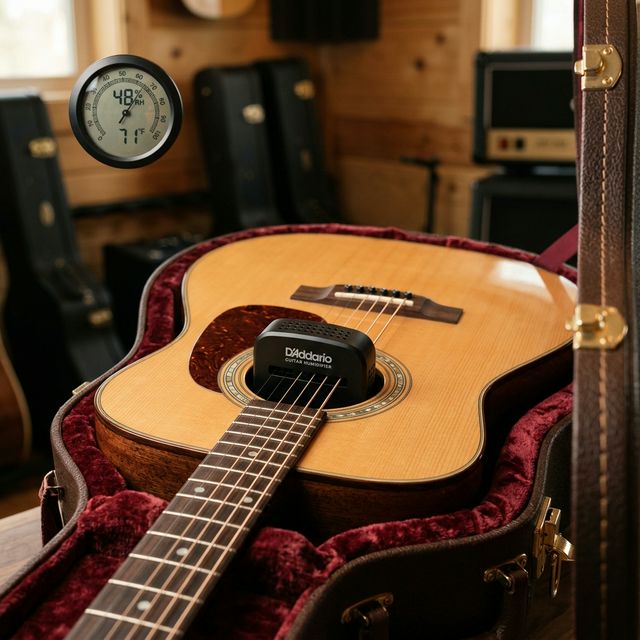
Humidity management is the most critical maintenance factor for acoustic guitars, and the most commonly neglected. Solid-wood acoustic guitars are especially vulnerable because the thin top plate responds dramatically to moisture changes.
The Danger Zone
| Humidity | Risk | Symptoms |
|---|---|---|
| Below 35% | Critical, cracking | Top cracks, fret sprout, sharp fret ends, low buzzy action |
| 35-44% | Watch closely | Slight top shrinkage, minor fret sprout |
| 45-55% | Ideal range | Guitar plays and sounds its best |
| 56-65% | Watch closely | Slight top swelling, higher action |
| Above 65% | Risk of damage | Belly bulge, glue softening, mold risk |
How to Manage Humidity
- Buy a hygrometer ($10-$15), a small digital humidity gauge. Place it in your guitar case
- In dry conditions (winter/AC): Use a soundhole humidifier like the D’Addario Humidipak ($15) or Oasis Guitar Humidifier ($20). These maintain 45-50% inside the case
- In humid conditions (summer/tropical): Use silica gel packets in the case and consider a room dehumidifier
- Always store in a case when not playing, hardshell cases buffer humidity changes dramatically
Our finding: We see more acoustic guitar damage from dry winter air than from any other cause. A Martin D-28 top repair costs $500-$1,500. A D’Addario Humidipak costs $15 and lasts 2-4 months. The math is obvious, yet most players learn this lesson the expensive way.
4. Store Your Guitar Properly
How you store your guitar when you’re not playing matters more than most people realize.
Best Storage Options (Ranked)
- Hardshell case, Best protection from humidity, temperature, dust, and physical damage. Essential for expensive instruments and travel
- Quality gig bag, Padded soft case. Good protection from dust and minor bumps. Easier to grab and play
- Wall hanger, Keeps the guitar accessible (you’ll play more!) and off the floor. Use a hanger with padded rubber or cork contacts. Avoid unfinished rubber hangers on nitrocellulose finishes
- Guitar stand, Convenient but exposes the guitar to dust, humidity changes, and accidental kicks. Use a padded stand
What to Avoid
- Never lean a guitar against a wall, it will fall. Guaranteed
- Never leave a guitar in a car, temperatures can exceed 140°F in summer (enough to melt glue) or drop below 20°F in winter (enough to crack finishes)
- Avoid direct sunlight, UV exposure fades finishes and can cause finish checking
- Don’t store near heating vents or radiators, the dry heat is devastating to acoustic tops
5. Keep Electronics Clean (Electric Guitars)
Scratchy, crackling pots and intermittent output jacks are the most common electrical problems on electric guitars, and they’re almost always caused by oxidation and dust buildup.
Cleaning Potentiometers (Volume/Tone Knobs)
When pots get scratchy:
- Remove the back plate or pickguard to access the electronics
- Spray a small amount of contact cleaner (DeoxIT D5 is the industry standard, ~$12) into the pot opening
- Rotate the knob back and forth 20-30 times to distribute the cleaner
- Let it dry for a few minutes before playing
Cleaning the Output Jack
If your cable connection cuts in and out:
- Spray contact cleaner into the jack
- Insert and remove a cable plug 10-15 times
- If the problem persists, the jack contacts may need bending or replacement ($5 part, $30-$50 if a tech does it)
Our experience: Nine times out of ten, a “broken” electric guitar just has dirty pots or a loose output jack. A $12 can of DeoxIT and 5 minutes of work saves a $75 repair bill. We keep a can in the shop at all times.
6. Get an Annual Professional Setup
Even if you do everything else right, a professional guitar setup once a year ensures everything is dialed in correctly. Physics and seasons work against you, neck relief changes with humidity, frets wear from friction, and intonation drifts as components settle.
What a Setup Includes
| Service | What They Adjust | Why It Matters |
|---|---|---|
| Truss rod adjustment | Neck relief/bow | Prevents buzzing and ensures comfortable action |
| Action height | String height at bridge/nut | Affects playability and tone |
| Intonation | Saddle positions | Ensures chords sound in tune everywhere on the neck |
| Nut slots | String slots depth and width | Eliminates tuning issues and open-string buzz |
| Fret level (if needed) | Worn frets | Eliminates dead spots and buzzing |
| Electronics check | Pots, jack, switch | Ensures clean signal |
Cost
- Basic setup (acoustic or electric): $50-$75
- Full setup with fret polish: $75-$100
- Setup with fret level: $100-$200
For the price of a nice dinner, you get a guitar that plays noticeably better. It’s the highest-ROI investment you can make in your instrument.
7. Change Strings on a Regular Schedule
Old strings lose brightness, intonation accuracy, and tuning stability. They also accumulate corrosion and grime that transfers to your frets and fretboard.
When to Change Strings
| Playing Frequency | Change Strings |
|---|---|
| Daily (1+ hours) | Every 1-2 weeks |
| Several times per week | Every 2-4 weeks |
| Weekend player | Every 4-8 weeks |
| Occasional | Every 2-3 months or when they sound dead |
Signs Your Strings Need Changing
- Dull, lifeless tone, new strings ring bright and clear; old ones thud
- Discoloration, dark spots, visible corrosion, or rough texture
- Won’t hold tune, old strings lose elasticity and drift constantly
- Intonation issues, chords sound in tune at the first fret but sour at the 12th
Check our guide on how to change guitar strings for step-by-step instructions on both acoustic and electric restringing.
Quick Maintenance Checklist
Print this and tape it inside your guitar case:
- After every session: Wipe down strings
- Weekly: Check tuning stability, inspect for visible issues
- At string change: Clean fretboard, polish frets, inspect nut and bridge
- Monthly: Check humidity level (acoustics), clean electronics if needed
- Annually: Professional setup by a guitar tech
- As needed: Replace worn strap locks, tighten loose hardware, replace dying batteries in active electronics
Keep Reading
- How to Change Guitar Strings, step-by-step restringing guide
- How to Set Up Your Guitar Like a Pro, complete DIY setup guide
- How to Tune a Guitar, every tuning method explained
- Best Guitar Strings for Every Style, our top picks
- Best Guitar Tuners, clip-on, pedal, and app compared

Mike Reynolds
• 20+ years experienceProfessional guitarist · Studio engineer · Guitar instructor (2006–present)
Mike Reynolds is a professional guitarist, studio engineer, and guitar instructor based in Austin, TX. He has recorded with regional acts across rock, blues, and country, and has been teaching private guitar lessons since 2006. Mike built his first home studio in 2008 and has since helped hundreds of students find the right gear for their budget and goals.