Guitar Setup Guide: Action, Intonation & Truss Rod
A proper guitar setup costs $50-$75 at a shop. Here is how to do it yourself with basic tools, adjust action, truss rod, and intonation.
Music Gear Specialist Review Desk
Gear Research & Analysis
ℹ️ Affiliate Disclosure: Music Gear Specialist earns from qualifying purchases through Amazon and other partner links. This doesn't affect our recommendations—we only suggest gear we'd use ourselves.
TL;DR: A guitar setup involves three adjustments: neck relief (truss rod), string action (bridge saddle height), and intonation (saddle position). Done correctly, these three adjustments transform a hard-to-play guitar into one that feels effortless. Budget 30-45 minutes for your first setup.
What Is Guitar Calibration?
Guitar calibration is the process of adjusting the instrument so the neck, strings, bridge, pickups, and tuning system work together. Most players use the word “setup,” but the checklist is the same: neck relief, action, intonation, pickup height, nut slots, tuning stability, and loose hardware.
If your guitar feels stiff, buzzes, goes sharp up the neck, or will not hold tune, it probably needs calibration. Start with the mechanical setup first, because intonation and pickup height depend on the neck relief and string action being correct.
| Calibration check | What it fixes | Start here |
|---|---|---|
| Neck relief | Buzzing or high action caused by neck bow | Truss rod adjustment |
| String action | Painful fretting, slow playing, fret buzz | Saddle height |
| Intonation | Chords sound out of tune above the fifth fret | Saddle position |
| Pickup height | Weak output or harsh magnetic pull | Pickup screws |
| Tuning stability | Guitar drifts after bends or chord changes | Nut slots, tuners, string winding |
For a guitar calibration at home, follow the setup order below. If the only problem is that notes sound sharp or flat at the 12th fret, use our focused guitar intonation guide after checking action and neck relief.
What Is a Guitar Setup?
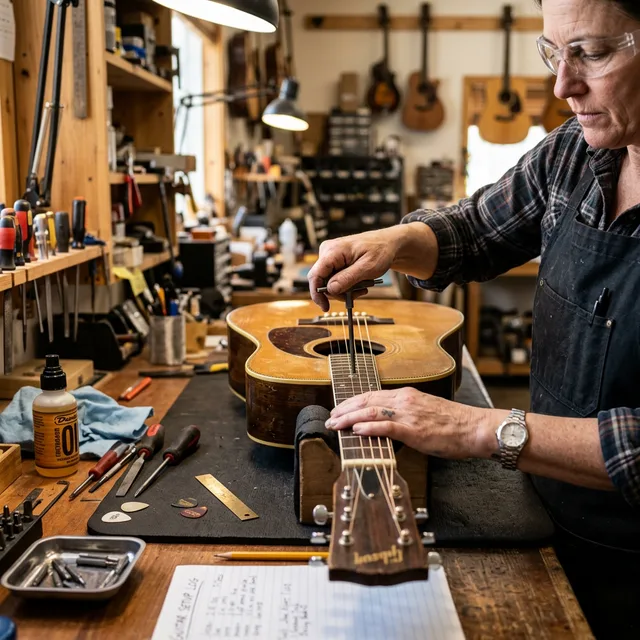
A “setup” is the process of adjusting your guitar’s mechanical components so it plays optimally. Even brand-new guitars from the factory often need a setup, they are manufactured to average specifications that may not suit your playing style, string gauge, or local climate.
The three core adjustments:
- Neck Relief, How much the neck bows under string tension
- Action, How high the strings sit above the frets
- Intonation, Whether notes play in tune across the entire fretboard
Get these three right and your guitar will feel dramatically better.
Tools You’ll Need
| Tool | Cost | Purpose |
|---|---|---|
| Allen key set (metric + imperial) | $8 | Truss rod and saddle adjustments |
| Small Phillips screwdriver | $3 | Intonation screws |
| Ruler with 64ths markings | $5 | Measuring action height |
| Feeler gauges (automotive) | $8 | Measuring neck relief |
| String winder + cutters | $5 | String changes during setup |
| Electronic tuner | $15 | Tuning for intonation checks |
| Capo | $10 | Neck relief measurement |
Total: ~$55, You’ll use these tools for years. Compare to $50-$75 per shop visit.
Step 1: Check and Adjust Neck Relief
What is neck relief? The slight forward bow in your guitar’s neck caused by string tension pulling it forward. A small amount of relief is normal and desirable, it prevents fret buzz. Too much relief and the action is unnecessarily high. Too little (back-bow) and strings buzz against frets.
How to Measure
- Capo the 1st fret, this eliminates the nut from the equation.
- Fret the low E string at the last fret where the neck meets the body (typically fret 15-17 on acoustics, fret 17-19 on electrics).
- Look at the gap between the bottom of the string and the top of the 7th or 8th fret. This gap is your neck relief.
Target Relief
| Guitar Type | Ideal Relief |
|---|---|
| Electric | 0.008” - 0.012” (about a business card thickness) |
| Acoustic | 0.010” - 0.014” |
Use your feeler gauges to measure precisely. Slide the gauge between the string and fret, it should just barely fit.
How to Adjust
The truss rod controls neck relief. The adjustment point is either:
- At the headstock (behind a cover plate or exposed at the nut)
- At the body end of the neck (requires reaching into the soundhole on acoustics)
To add more relief (neck is too straight/back-bowed): Turn the truss rod nut counter-clockwise (loosen).
To reduce relief (neck has too much bow): Turn the truss rod nut clockwise (tighten).
⚠️ Critical rules:
- Make only quarter-turn adjustments (90 degrees max)
- Wait 24 hours between adjustments for the wood to settle
- Never force a stuck truss rod, take it to a professional
- Retune after each adjustment
Step 2: Set String Action
What is action? The height of the strings above the frets, measured at a specific fret (usually the 12th fret). Lower action = easier to play and faster. Higher action = more sustain, less buzz, better for slide guitar.
How to Measure
- Tune your guitar to pitch with the truss rod properly adjusted.
- Place your ruler on top of the 12th fret.
- Measure the gap from the top of the fret to the bottom of the string.
Target Action Heights
| Guitar Type | Low E (6th) | High E (1st) |
|---|---|---|
| Electric (low) | 4/64” (1.6mm) | 3/64” (1.2mm) |
| Electric (medium) | 5/64” (2.0mm) | 4/64” (1.6mm) |
| Acoustic | 7/64” (2.8mm) | 5/64” (2.0mm) |
How to Adjust
Electric guitars: Adjust individual saddle heights using the small hex screws on each bridge saddle. Turn clockwise to raise, counter-clockwise to lower.
Acoustic guitars: The saddle (the white strip on the bridge) controls the action. To lower, remove the saddle and sand the bottom flat on fine sandpaper. To raise, add a thin shim under the saddle. This is less forgiving than electric guitar adjustment, remove material slowly.
Important: If you cannot get the action low enough without buzzing, your neck relief may need more adjustment, or your frets may need leveling (a professional job).
Step 3: Set Intonation
What is intonation? Whether your guitar plays in tune across the entire fretboard. If an open string is perfectly tuned but fretted notes at the 12th fret are sharp or flat, your intonation is off.
How to Check
- Tune the open string perfectly with your electronic tuner.
- Play the harmonic at the 12th fret (lightly touch the string directly over the fret wire and pluck).
- Fret the note normally at the 12th fret and compare to the harmonic.
If the fretted note equals the harmonic: ✅ Intonation is correct. If the fretted note is sharp: The string length needs to increase, move the saddle back (away from the neck). If the fretted note is flat: The string length needs to decrease, move the saddle forward (toward the neck).
How to Adjust
Electric guitars: Turn the intonation screw on the back of the bridge to move each saddle forward or back. Make small adjustments, retune, and recheck. Repeat until the 12th fret note matches the harmonic.
Acoustic guitars: Intonation adjustment is extremely limited. The saddle position is essentially fixed. If intonation is significantly off on an acoustic, a compensated saddle (angled or notched) from a luthier is the solution ($30-$60 installed).
The Setup Order Matters
Always adjust in this order:
- Neck relief first, This affects everything else
- Action second, Now that the neck is straight, set string height
- Intonation last, Now that action is set, fine-tune intonation
If you change string gauges, start over from step 1.
When to See a Professional
Some adjustments require specialized tools and experience:
- Fret leveling and crowning, Uneven frets cause persistent buzzing ($100-$200)
- Nut slot filing, Slots that are too tight or too wide ($20-40)
- Electronic repairs, Crackling pots, dead pickups ($30-$100)
- Structural repairs, Cracked necks, warped bodies (varies widely)
A good guitar tech is worth their weight in gold. Ask at your local music shop for recommendations.
Related articles: Best Guitar Tuners, How to Change Guitar Strings, Best Guitar Strings for Every Style, 8 Essential Guitar Chords for Beginners
- Best Guitar Straps, comfort and security for standing play

Music Gear Specialist Review Desk
Research-based reviewsResearch-based reviews · Manufacturer specs · Verified owner feedback
We review guitars, amps, pedals, and recording gear the honest way: spec sheets, published measurements, and the collected experience of working musicians and verified owners.