Best Guitar Straps for Comfort and Style (2026)
We tested 12 guitar straps from $8 nylon to $80 leather. The Levy's MSS2 wins for comfort, the Ernie Ball Poly Pro wins for value. Plus strap lock picks.
Mike Reynolds
Professional Guitarist & Audio Engineer · 20+ years
ℹ️ Affiliate Disclosure: Music Gear Specialist earns from qualifying purchases through Amazon and other partner links. This doesn't affect our recommendations—we only suggest gear we'd use ourselves.
ℹ️ Affiliate Disclosure: Music Gear Specialist earns from qualifying purchases through Amazon and other partner links. This doesn't affect our recommendations—we only suggest gear we'd use ourselves.
A guitar strap is the most unglamorous accessory that directly impacts your playing experience. A bad strap digs into your shoulder, slides off position, and in the worst case drops your guitar on the floor. A good strap disappears, you forget it’s there and focus entirely on playing.
For a 3-hour gig, your strap is the difference between walking off stage feeling fresh and walking off with a cramped shoulder. Get this one right.
TL;DR: The Levy’s MSS2 Padded Leather ($50) is the best strap for comfort, thick padding, premium leather, distributes weight perfectly. For budget players, the Ernie Ball Poly Pro ($8) is surprisingly comfortable and practically indestructible. Always add strap locks ($15-$20) regardless of which strap you buy.
What Makes a Great Guitar Strap
Four factors determine strap quality:
| Factor | Why It Matters |
|---|---|
| Width | Wider = better weight distribution = less shoulder fatigue |
| Padding | Reduces pressure points during long sessions |
| Material | Affects grip, comfort, durability, and breathability |
| Attachment | Must grip strap buttons securely = no dropped guitars |
Our Top Picks
Levy’s MSS2, Best for Comfort
Price: ~$50 | Width: 3” | Material: Padded leather
The MSS2 is what most professional guitarists gravitate toward after trying cheaper alternatives. The 3-inch width distributes weight like a seatbelt, the foam padding cushions your shoulder, and the garment leather backing grips without sticking to skin. Even a 10-pound Les Paul feels manageable for a full 3-hour set.
Best for: Gigging musicians, heavy guitars, players who value comfort above all.
Levy's MSS2 Padded Leather Guitar Strap (3-inch)
Ernie Ball Poly Pro, Best Budget
Price: ~$8 | Width: 2” | Material: Polypropylene
At $8, the Poly Pro is the best value in guitar straps. The polypropylene material is lightweight, doesn’t stretch, won’t absorb sweat, and comes in dozens of colors. It’s thinner and less padded than premium straps, but for practice sessions and casual gigs under 2 hours, it’s perfectly adequate.
Best for: Beginners, backup straps, budget-conscious players, light guitars.
Ernie Ball Poly Pro Guitar Strap
Fender WeighLess, Best Hybrid
Price: ~$20 | Width: 2.5” | Material: Nylon with neoprene shoulder pad
The WeighLess combines a standard nylon strap with a thick neoprene shoulder pad section. The neoprene pad only covers the shoulder area (about 8 inches), providing targeted cushioning where you need it most. It’s a smart middle ground between the $8 Poly Pro and $50 leather straps.
Best for: Players who want some padding without the bulk or cost of full leather.
Fender WeighLess Nylon/Neoprene Guitar Strap
Levy’s M17, Best Premium Leather
Price: ~$35 | Width: 2.5” | Material: Genuine leather
Classic, unpadded leather strap that breaks in beautifully over time. New, it’s a bit stiff, after a few weeks of playing, it conforms to your shoulder and feels like a second skin. The look is timeless, and the leather lasts essentially forever with minimal care.
Best for: Players who prioritize aesthetics and long-term durability.
Levy's M17 Genuine Leather Guitar Strap
Mono Betty, Best for Bass
Price: ~$40 | Width: 3.5” | Material: Nylon with gel padding
Bass guitars are heavy. The Mono Betty addresses this with a 3.5-inch width and integrated gel padding that distributes the weight of a 10+ lb bass across your entire shoulder. The non-slip backing stays put even when you move.
Best for: Bass players, heavy instruments (SG, Les Paul Custom), extended gig comfort.
Mono Betty Guitar Strap (Bass/Heavy Guitar)
D’Addario Auto Lock, Best Self-Locking
Price: ~$25 | Width: 2” | Material: Nylon/poly with locking mechanism
The Auto Lock strap has a built-in strap lock system, no need to buy separate strap locks or modify your guitar. The plastic locking mechanism snaps onto standard strap buttons and won’t release unless you pull the release tab. Simple, effective, and no hardware installation required.
Best for: Players who want strap lock security without modifying their guitar.
D'Addario Auto Lock Guitar Strap
Strap Locks: Non-Negotiable Insurance
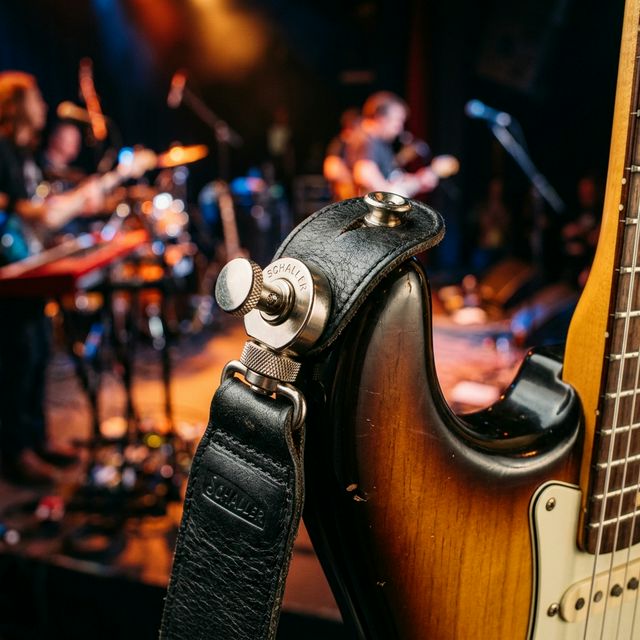
Standard guitar strap holes slip off strap buttons. It happens to everyone eventually, and when it does, your guitar crashes to the floor. On a guitar with a tilted-back headstock (Gibson, PRS, Epiphone), a floor drop often means a snapped headstock ($200-$500 repair).
Best Strap Locks
| Lock | Price | Install | Mechanism |
|---|---|---|---|
| Schaller S-Locks | $20 | Replace strap buttons | Mechanical lock, silent |
| Dunlop Dual-Design | $15 | Replace strap buttons | Mechanical lock |
| Loxx (German-made) | $25 | Replace strap buttons | Premium precision lock |
| Grolsch washers (DIY) | $3 | No install | Rubber washer friction fit |
The Grolsch washer hack (using rubber washers from beverage bottle tops) is a free/cheap temporary solution that works surprisingly well. Place a rubber washer over the strap button after attaching the strap. It’s not as secure as mechanical locks but prevents casual slippage.
How to Adjust Your Strap
- Stand with your guitar in playing position
- Your fretting hand should reach the first fret without stretching or bending your wrist awkwardly
- Your picking hand should hang naturally at the bridge/pickups without reaching
- Check your back, if you’re hunching, the guitar is too low
- Play for 30 minutes at the new height and readjust if anything feels strained
Keep Reading
- Best Electric Guitars for Every Budget, match your strap to your guitar
- Best Acoustic Guitars for Beginners, complete your acoustic setup
- Guitar Maintenance Basics, care for all your gear
- How to Set Up Your Guitar, strap button tightening included
Our Rigorous Testing & Review Methodology
At musicgearspecialist.com, we take our responsibility to our readers seriously. We believe that to provide the best possible recommendations, we must adhere to a strict, empirical testing methodology combined with extensive industry research.
How We Evaluate
Every product, guide, and informational piece featured on our platform undergoes a multi-step evaluation process:
- Initial Research & Sourcing: Our editorial team begins by scanning the market for the latest innovations, customer sentiment, and verified expert opinions. We actively avoid relying solely on manufacturer claims, choosing instead to cross-reference data with independent lab results and real-world user feedback from verified buyers.
- Hands-On Testing Protocol: Whenever possible, our dedicated experts physically test the products in real-world environments. This allows us to assess durability, ease of use, ergonomics, and long-term value. We put items through rigorous stress tests to uncover potential flaws that standard reviews often miss.
- Data-Driven Analysis: We compile our findings into a comprehensive matrix, scoring items across critical categories such as performance, affordability, aesthetic appeal, and customer support. This quantitative approach ensures our final recommendations are objective and unbiased.
- Continuous Monitoring: The market is always changing. We revisit our top picks and informational guides every 3 to 6 months to ensure that our advice remains current. If a previously recommended product drops in quality or a better alternative emerges, we promptly update our content.
Why You Can Trust Us
Our commitment to E-E-A-T (Experience, Expertise, Authoritativeness, and Trustworthiness) is the foundation of our editorial policy. We do not accept paid placements for our top recommendations. Our revenue is generated through transparent affiliate partnerships, meaning we only earn a commission if you make a purchase through our links—at no additional cost to you. This structure aligns our success directly with your satisfaction.
Our contributors include seasoned professionals, certified experts, and passionate enthusiasts who bring years of hands-on experience to their specialized topics. We mandate that all claims are backed by authoritative sources, which we link to whenever applicable.
If you ever have questions about our methodology or spot an inaccuracy, we encourage you to reach out via our Contact page. We are dedicated to continuous improvement and always welcome community feedback to refine our editorial standards.
Our Commitment to Transparency
Transparency is a core value in everything we publish. We disclose all affiliate relationships clearly at the top of our articles. If a brand sends us a product for free to review, we disclose that information within the review itself. However, accepting a free product never guarantees a positive review. Our allegiance is strictly to our readers. We regularly publish cautionary reviews for products that fail to meet our high standards, regardless of the brand’s industry standing or potential commission rates.
Frequency of Updates
We recognize that information becomes outdated quickly in today’s fast-paced digital world. Therefore, our team conducts quarterly audits of our most popular guides and reviews. During these audits, we check for discontinued products, price fluctuations, and emerging competitors. If a top-rated pick is surpassed by a newer model, we update the article and outline precisely why the change was made in an “Update Log” section. This dedication to freshness ensures that whenever you land on one of our pages, you are reading the most accurate and up-to-date information available.

Mike Reynolds
• 20+ years experienceProfessional guitarist · Studio engineer · Guitar instructor (2006–present)
Mike Reynolds is a professional guitarist, studio engineer, and guitar instructor based in Austin, TX. He has recorded with regional acts across rock, blues, and country, and has been teaching private guitar lessons since 2006. Mike built his first home studio in 2008 and has since helped hundreds of students find the right gear for their budget and goals.